

The advantages of having a presence on the internet through a website are undeniable, namely: make your business known; divulge products and/or services; locate the company and provide contacts. All these aspects enhance the potential acquisition of customers and partnerships, which can be absolutely essential for your company to succeed.
However, it’s common for many entrepreneurs to have a restricted budget to give life to a project. Therefore, the following question arises: how to create an efficient website to achieve the best price-performance relationship?
To overcome this obstacle it is necessary first to define a strategy for your website and for that you need to answer a few questions:
- Which kind of content are you going to insert into the website? For example, texts, images, videos, contact forms, questionnaires, search fields, etc.;
- How often will you have to update the content?
- Who will be responsible for maintaining the content?
- What can users do on the site? For example, subscribe to a newsletter, request a quote, make a purchase, fill out a questionnaire, etc.
- What are the goals you want to achieve with the implementation of the site?
The answers to the questions listed above will enable you to clarify ideas, get a sense of how complex your site will be, and have a strategy to work on.
After the strategy is defined, you will need to familiarize yourself with some aspects. These aspects will be presented below in 3 thematic areas, to explain what is fundamental to know, when you are implementing a website for the first time.
1. Create and register a domain
The first thing to do will be to verify if the domain or website name, that ideally, you would like to have (usually the name of the company or brand), is available to be registered. The domain will serve to identify the website on the internet and to have your emails customized, for example, info@yourcompanydomain.pt.
If your business activity is only carried out on Portuguese territory, you should choose the top-level domain (TLD) pt, the TLD com is generally selected by companies operating in several countries and the org TLD is more suitable for non-profit institutions. Nevertheless, you will see that there are many options of TLD available to pick, according to the area of activity of your company.
Registering a domain may cost approximately € 9.00 to € 20.00 per year. Before you register, it’s advisable to compare several companies and check which one has the best offer. The cost of registering a domain varies depending on the selected extension; the modality of registration (annual, biannual, triannual); and the type of hosting you will associate. Some companies offer domain registration, depending on the type of hosting that is chosen. This subject will be explained further below.
2. Choose a hosting service according to your needs
While you compare the prices to register a domain, you can also compare the prices of hosting plans that each company provides. The hosting service is the rental of space in a server connected to the internet, where your website data is going to be (which will contain all files, website pages, images, videos, etc.) and will have the domain associated. The companies offer several types of hosting plans, which meet the specific needs of each client. The needs vary according to the requirements of the website and the strategy adopted by the company. Here are some important aspects that you need to consider before choosing a hosting plan as they will have an impact on your daily work and website efficiency:
- E-mail configuration: how many e-mail addresses do you need for your business and are possible to create in different plans;
- Sending emails: how many emails can you send per hour? This is especially meaningful if you want to send frequent newsletters or marketing emails, with lists that have more than 2000 subscribers;
- Compatibility of programming languages: the type of hosting has to be compatible with the programming language in which your website will be built. For example, Linux hosting has compatibility with PHP, MYSQL, HTML, TOMCAT programming languages while Windows hosting is compatible with ASP, NET, MYSQL, HTML, TOMCAT programming languages;
- Digital certificates: attest to the security level of the site. There are several types of certificates according to the level of security that your website needs to have. A site that only has a company presentation and does not collect data, does not need to have a security certificate. A website that collects user data needs to have a security certificate and one that has an online store and allows to make payments will probably need to get one of the most expensive certifications. There are many types of digital certificates and some may be included in the price of hosting. Prices may range from € 10.00 to € 300.00 per year.
- Shared server, cloud server, or dedicated server: when you choose your hosting service, you should know which one of the mentioned modalities you need. For the majority of websites, the shared server option is sufficient. However, if you plan that the website will have a high volume of visitors and will allow users to perform several operations simultaneously, it might be best to pick a cloud server or dedicated server.
- Assistance and technical support: check how the technical support will be done (email, chat, and/or telephone) and choose a hosting plan that has the service you prefer.
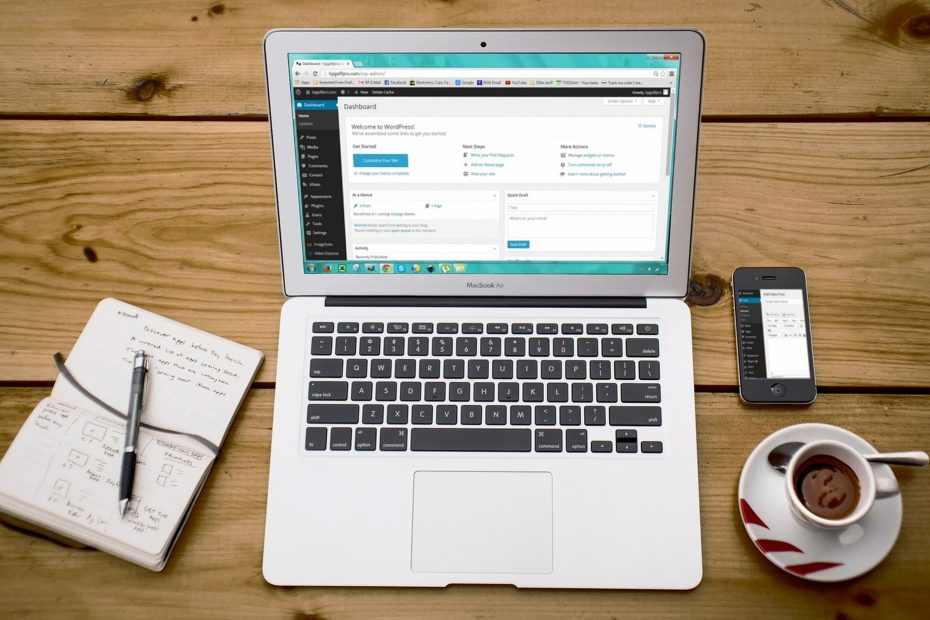
- Content management software that you can use to create and manage the site: they are provided by the hosting plan. For example, WordPress and Joomla are generally rated as some of the best content management software, which do not require programming skills and are available in many hosting plans.
Prices of hosting plans range from € 40.00 to € 400.00 per year. If you have doubts about the plan that best fits your needs, you can start by choosing and testing one of the cheapest plans. It will be possible to upgrade it at any moment to a more expensive plan, if necessary.
3. Select a content management software appropriate to the site type
There is currently excellent free content management software such as WordPress and Joomla, that may be included in the chosen hosting plan which can allow an easier configuration. The use of this type of software is very intuitive and does not require programming knowledge. For most sites, the use of these or other content managers may be adequate.
However, if you want to have an online store, it will be better to make a survey and consult two or three companies (where you consider registering the domain and hiring the hosting), to see if you can use free content management software, that offers all the characteristics and functions of the website you want to implement.
If you need a customized website, you will have to present the strategy of what you want, in order to obtain a detailed budget for the execution of the service. Make sure that the budget already includes content management, to avoid that you become dependent on other companies to do it. It may be a more expensive solution, but it will be more functional and profitable in the medium and long term.
Achieving the best price-quality relationship
In short, in order to achieve the best value for your money in the implementation process of your company website, you should start by defining the strategy of the site, which will help to clarify ideas and goals and save a lot of time and money. After deciding on the strategy to adopt, you can then start the process of implementing the site: creating a domain that shows the potential of your brand; selecting a hosting plan that fits the needs of what you intend to do with your website; and finally, select a content management software that guarantees long-term efficient maintenance.